Find your room’s focal point
Stand in your doorway: the first thing you see should be on purpose. How to pick and build a focal point in a small living room, from free to $120.
What it costs
| Large poster frame, 24×36 in | $35 |
| Printed public-domain artwork | $15 |
| Picture light (plug-in, rechargeable) | $30 |
| Tall faux plant to frame it | $40 |
| Total | $120 |
Rough US prices at the time of review. Prices change — check before you buy, and skip what you already own.
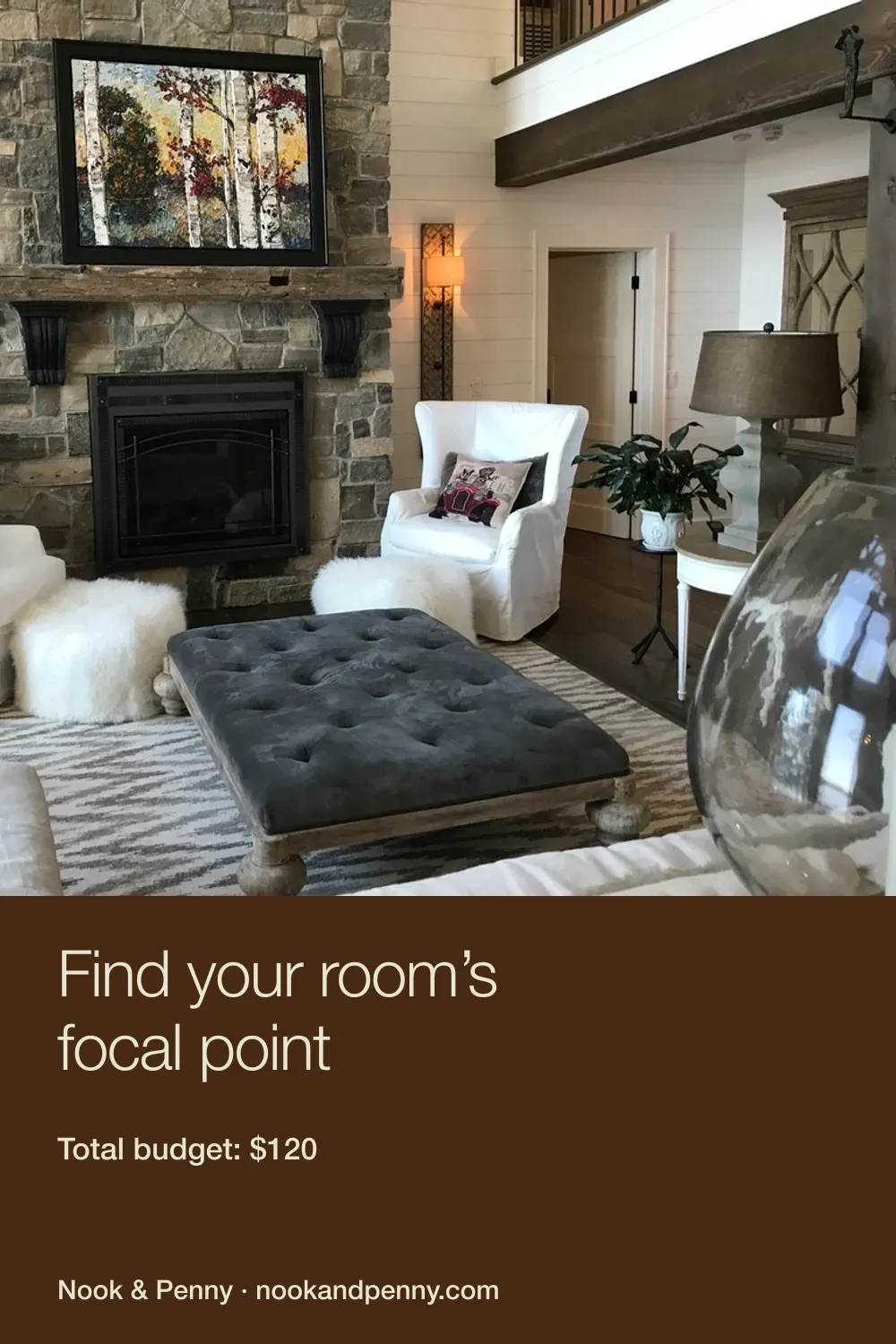
Your living room’s focal point is whatever you see first from the doorway. In a small room it should be one thing you chose on purpose — a large print, a window with long curtains or a styled shelf — and everything else should be quieter.
The doorway test (2 minutes, free)
- Stand in the main doorway, the way a guest would.
- Take a photo with your phone at eye level.
- Look at the photo and write down the first three things you notice.
If the first thing is the TV, a radiator, the laundry rack or the back of the sofa, that’s your problem. A small room has no “other side” to hide things on — the doorway view is the room.
Pick one focal point (and only one)
Here are the options, roughly from cheapest to most work:
| Focal point | Cost | Effort | Renter-safe? |
|---|---|---|---|
| The window, with curtains hung high and wide | ~$65 | 1 hour | Yes (2 screw holes per bracket) |
| One oversized print above the sofa | ~$50 | 30 minutes | Yes (strips or 1 nail) |
| A styled bookshelf | Free–$40 | 1 afternoon | Yes |
| An accent wall (removable wallpaper) | ~$45 | 1 afternoon | Usually, on smooth walls |
| A statement lamp or pendant | ~$30–$60 | 30 minutes | Yes (plug-in) |
Our pick for most small rooms: one big print. It’s cheap, it’s reversible and it reads from across the room. If your window has a view, use the window instead — see our guide to hanging curtains high and wide.
Size matters more than the art
The most common mistake is art that’s too small. In a small room, a small frame doesn’t look delicate; it looks lost. Use these numbers:
- Above a sofa: art (or a group of frames) about two-thirds of the sofa’s width. For a 72-inch sofa, aim for about 48 inches.
- On an empty wall: at least 24×36 inches if it’s going to be the focal point.
- Height: the center at about 57 inches from the floor. Our art hanging cheat sheet has the rest.
A 24×36 poster frame costs about $35. Print a public-domain painting from a museum’s open-access collection at a copy shop for about $15, and you have a focal point for $50.
The focal point in every room
| Room | Natural focal point | If there isn’t one |
|---|---|---|
| Living room | The window or the wall behind the sofa | One large print above the sofa |
| Bedroom | The headboard wall | Paint or wallpaper behind the bed, or a big print above it |
| Studio | Whatever you see from the door — ideally the window or the living zone | A styled bookshelf divider facing the door |
| Entry | The wall you face when the door opens | A round mirror above a slim shelf — see no entryway? fake one |
| Dining nook | The table under a pendant | A plug-in pendant hung 30–36 in above the table |
Make everything else quieter
A focal point only works if it doesn’t compete. Once you’ve picked yours:
- Move the clutter out of the sightline. Mail, chargers and baskets go to the side walls, not the wall you see first.
- Match the frames and shelves around it. One frame color, one wood tone.
- Hide the cables. A $10 cord cover does more than a $100 decoration.
- Turn the TV into “furniture.” Mount it low, hide cables in the wall cover, and put a plant or lamp beside it.
How to style a bookshelf as a focal point
- Empty it completely. Start from zero.
- Books first, in two ways: some standing upright, some lying in stacks of 3–5. Group by color or size, not by title.
- Leave about a third of each shelf empty. Empty space is what makes a shelf look styled instead of stored.
- Use a zigzag: a big object top left, middle right, bottom left, so the eye moves across.
- One object per shelf, at most: a plant, a framed photo, a bowl. Odd numbers (1 or 3) look more natural.
- Baskets on the bottom shelf for the things you actually need to hide.
- Step back to the doorway and remove one thing.
When the TV has to be the focal point
In many small living rooms there’s only one wall for the TV and it’s the one you see first. Make it look intentional:
- Mount it low. The center of the screen around eye level when you’re sitting, often 40–45 inches from the floor — not above a fireplace-style height.
- Hide every cable with an in-wall kit (with permission) or a paintable cord cover.
- Give it company: a low console wider than the TV, a plant or lamp on one side, and nothing stacked on top of it.
- Use a dark wall color or a frame-style TV mode if you want the screen to blend in when it’s off.
Three budgets
| Budget | What you get |
|---|---|
| $0 | Move the clutter out of the doorway view, style the bookshelf with what you own, center existing art at 57 in |
| $50 | One 24×36 framed print ($35 frame + $15 print) above the sofa |
| $120 | The print, a rechargeable picture light ($30) and a 5-ft faux tree ($40) beside it |
Where to get big art for almost nothing
The cheapest way to get a large print is a public-domain artwork from a museum’s open-access collection, printed at a copy shop. Several major museums — including The Metropolitan Museum of Art, the Art Institute of Chicago and the National Gallery of Art — publish high-resolution images of public-domain works that anyone can download and print.
- Pick a work with simple shapes and a palette that matches your room (landscapes and botanical studies work well in small rooms).
- Download the largest file available.
- Print it as an engineering print or poster at a copy shop: a 24×36 inch black-and-white engineering print often costs under $10; color posters cost more.
- Put it in a 24×36 poster frame (~$35) and hang it centered at 57 inches.
Light it
At night, the brightest spot in a room becomes the focal point whether you like it or not. Put that brightness where you want the eye to go: a rechargeable picture light above a print (~$30), or a floor lamp next to the styled shelf. More on that in layered lighting under $100.
Frame it with height
A tall plant or a floor lamp on one side of the focal point acts like a frame. It also pulls the eye up, which makes the ceiling feel higher. A 5-ft faux tree is about $40.
A real example, with numbers
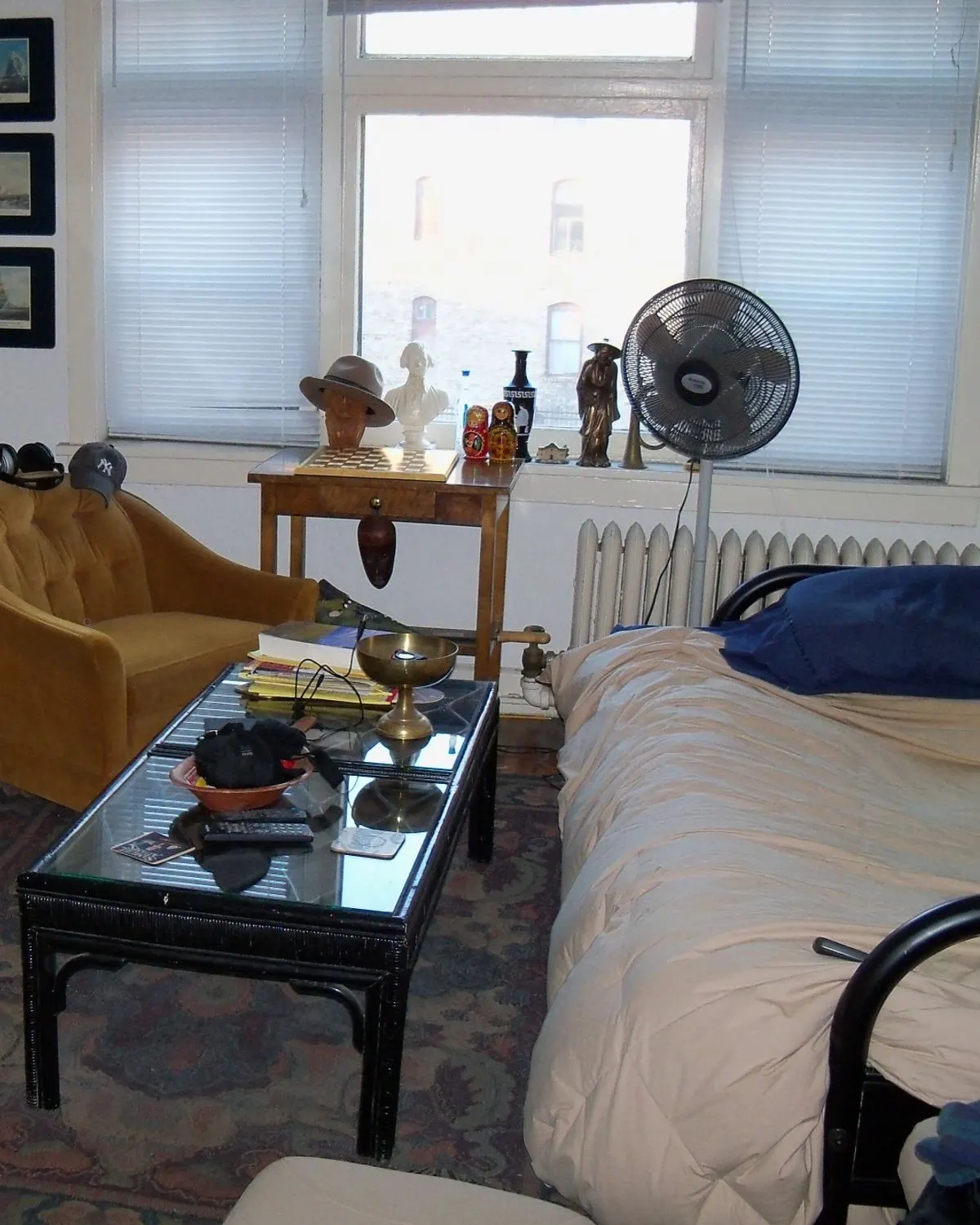
A 11×12 ft living room, sofa on the long wall facing the door. Before: the doorway view was the TV on a low cabinet with a tangle of cables, a laundry basket and two tiny frames at different heights.
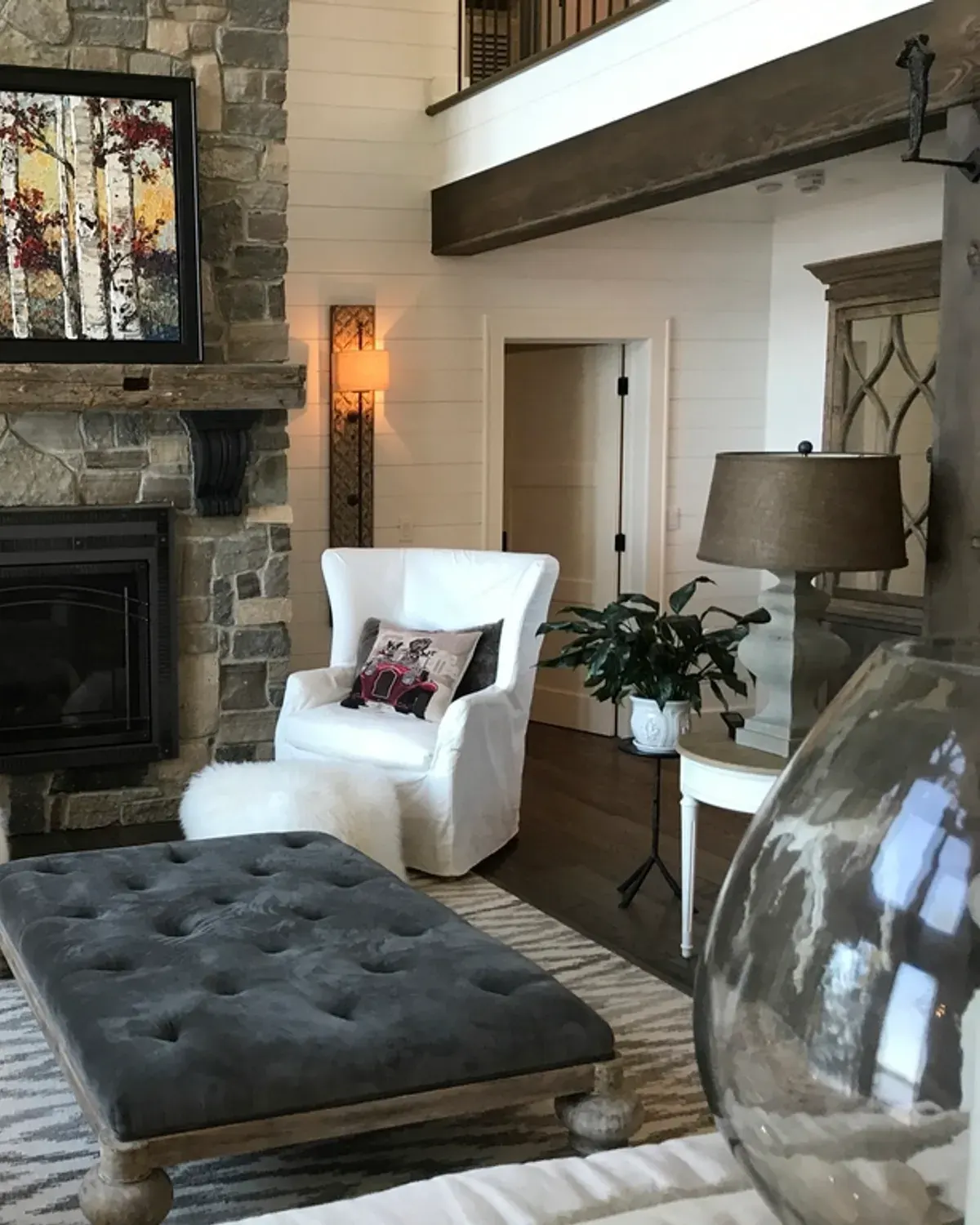
After (total $120): the TV moved to the side wall; a 24×36 framed print centered above the sofa at 57 inches; a picture light; a faux olive tree in the corner beside the sofa. The doorway photo now shows one big print, warm light and green — and the room reads as calm instead of cramped.
Common focal point mistakes
- Art too small and too high. The two together are the most common. Go bigger, and center at 57 in — the art height cheat sheet has the formula.
- Two focal points fighting. A bold rug and a bold print and a bright sofa means nothing wins. Pick one bold thing.
- The focal point is behind you. Check where you look when you walk in, not where you sit.
- Lit the wrong thing. At night, the brightest spot wins. If that’s the TV cabinet, move a lamp.
- Clutter “around” the focal point. Baskets, chargers and piles in the same view cancel it.
Redo the test
Take the doorway photo again. If the first thing you notice is the thing you chose, you’re done. If not, remove one more object from that sightline and try again.
Want to check the rest of the room? Take our 1-minute test: does your living room look small?
Quick answers
How do I find the focal point of my room?
Stand in the doorway and take a photo at eye level. The first thing you notice in the photo is your current focal point — decide whether it's the thing you want people to see.
Can a rug be a focal point?
In a small room it can, if everything else is plain. Usually a rug works better as the base and something at eye level — art, a window, a shelf — as the focal point.
What is a focal point in a living room?
The first thing your eye lands on when you walk in. In a small room it should be one deliberate thing — a big piece of art, a window with long curtains, or a styled shelf — not the TV cables or a pile of mail.
Can the TV be the focal point?
It can, but it usually looks better when it shares the wall with something else: mount it, hide the cables and put art or shelves around it so the black rectangle isn't the only thing on the wall.
Should a small room have more than one focal point?
No. Two competing focal points make a small room feel busy and smaller. Pick one and keep everything else quieter.